WV Code: §5-2-1 General Duties of the Secretary of State
"The secretary of state shall be the keeper of the seals of the state, keep a journal of executive proceedings, arrange and preserve all records and papers belonging to the executive department, be charged with the clerical duties of that department, and render to the governor, in the dispatch of the executive business, such service as he may require."
The Secretary of State has been assigned as the keeper of various other records, either by a constitutional provision or by statute.
Although these are not the Governor's papers, they are maintained in the Executive Records section.
Some of these documents are available online by using the Executive Journal Search.
Select a tab below for more information about these records.
Other Documents and Miscellaneous Records
About PSDs
Public service districts or "PSDs" are public corporations established by county commissions with approval of the West Virginia Public Service Commission. These local entities manage the development and maintenance of water, sewage and gas systems covering areas specified by the county commission. They were authorized by the Legislature to help extend services to rural areas and allow municipal water and sewage systems to become more efficient by sharing services and resources with surrounding areas.
Lists of Districts and Members
West Virginia law requires each county commission to file annually a list of the names of the public service districts within their respective counties, and names of the current members of each PSD board with the Secretary of State. The filing is due no later than July 1 of each year. Upon receipt of the list, the document is placed in the Executive Records section and is viewable online in the Executive Journal Search.
Related Laws
The requirement for this filing is specified in W.Va. Code §16-13A-2.
What are Facsimile Signatures?
The actual legal basis for using a signature stamp (a facsimile of an official's actual signature) is specifically authorized under the Uniform Facsimile Signatures of Public Officials Act only for executing public securities and instruments of payment. This act permits the authorized state, county and local officials to eliminate manual signing of checks, for example.
There is a common misconception that once a facsimile signature certificate is filed, an officer's signature by stamp or other device will have legal authority on any document to which it is applied. The law has made specific provision for the use of stamped signatures in specific cases not governed by the Act.
Who Files Facsimile Signature Certificates?
Under the Act, any authorized officer may use a facsimile signature on instruments of payment, and the Act defines authorized officer quite broadly as "any official of this state or of any of its departments, agencies, boards, commissions or other instrumentalities or of any of its public corporations, political subdivisions, municipal corporations or other governmental units whose signature to a public security or instrument of payment is required or permitted."
While all of these authorized officers may lawfully use facsimile signatures for the purposes defined in the Act, they must first execute a facsimile signature certificate and file it with the Secretary of State.
Facsimile Signature Certificate Forms
Select the appropriate form:
Requesting Information and Copies of Enrolled Bills and Joint Resolutions
Copies of enrolled bills and joint resolutions may be ordered. Contact the office of the Clerk of the body which initiated the bill.
Although it takes some time after the session to get enrolled bills prepared, when that is complete, you will be able to view the text of an enrolled bill at no cost on the WV Legislature website.
Copies of enrolled bills and joint resolutions adopted before 1973 are maintained by the Division of Archives and History.
Since 1973, the original copies remain with the Secretary of State.
Enrolled Bills — Official Acts of the Legislature
Joint Resolutions
Members
The seven member Board is comprised of six elected state constitutional officers including the Governor, the Secretary of State, the State Auditor, the State Treasurer, the State Attorney General, and the Commissioner of Agriculture. The State Superintendent of Schools is appointed as the seventh member.
Together they make up the Board of Public Works, which is established, by law, as a public corporation.
The Secretary of State serves as secretary to the Board, and the minutes and other documents are maintained in the Secretary of State's office.
Responsibilities
The Legislature chose to assign certain responsibilities to a group of high officials answerable to the voters rather than to a single official or executive agency. Among those important duties are:
- Approval of the purchase, transfer or sale of state real property
- Assessment of public utility property
- Approval of bonds prior to issuance by a state department or institution, county, board of education or municipality
- Establishment of the levies on property at the rates set by law
Public Utility Assessed Valuations
One of the major roles of the Board relates to determining the valuation of public utility property for the purpose of tax assessments. Although most real and personal property is assessed at the county level, public utilities are unique in that their property extends through many counties.
Rather than have each of the fifty-five county assessors attempt to determine the value of the telephone lines and railroad tracks in their respective counties, the property is appraised and assessed by the state.
The owner or operator of every public utility is required to file a report with the Tax Commissioner no later than May 1 itemizing the utility's property for the previous calendar year in the detail set out by law. Those who must report include the owner or operator of every:
- railroad, railroad toll bridge, and railroad car line transporting freight or passengers
- express company or express line used to transport freight
- oil, gas or water pipeline, electrical or other power transmission line
- telegraph or telephone line
- gas company and electric company
- hydroelectric company for the generation and transmission of light, heat or power
- water company furnishing or distributing water
- public service corporation or person engaged in public service business whose property is located, wholly or in part, within this state
Utility companies who have questions about these reports may contact the Tax Department at (304) 558-3940 for assistance.
The Tax Commissioner reviews the reports, obtains any additional information needed, sets out the tentative assessment for each utility and mails the owner or operator of the utility a copy. The Commissioner must deliver the tentative assessments to the Board of Public Works by September 15, and the Board then officially orders the assessments at a meeting to be held no later than October 1.
The Board of Public Works gives notice to the utility companies of their right to contest the valuation before the Board, either in writing or at a hearing or both.
- Questions about the details of the valuation should be directed to the Tax Department.
- Written appeals or written requests for a hearing should be directed to:
Attn: Board of Public Works
Secretary of State
Bldg. 1, Suite 157-K
1900 Kanawha Blvd. East
Charleston, WV 25305
As a result of these appeals, the Board may reconsider and cause the values to be altered. After the final determinations are made, the Board certifies the assessments to the Auditor and to each public utility.
Textbook and Instructional Materials Bonds
One bond that is specifically required to be filed with the Board of Public Works, for which the Secretary of State serves as Secretary, is the bond for vendors who contract with the State to sell textbooks and instructional materials to the fifty-five county school systems. Statewide selection of textbooks is conducted through the State Board of Education and selected vendors enter into contracts and execute a surety bond to assure the terms of the contract are met. These documents are public information.
Related Laws
Several sections of West Virginia Code detail the duties of the Board of Public Works:
- Board of Public Works §5-4-1 and 2
- General Duties and Power of Commissioner and Appraisers §11-1-2
- Aiding Board of Public Works, Auditor and Treasurer §11-1-3
- Returns of Property to Board of Public Works §11-6-1 et. seq.
- Levies by Board of Public Works; Certification §11-8-8
- Execution of Contracts and Bonds §18-2A-4
The Great Seal
As "keeper of the seal," the Secretary of State controls the use of the seal for any purpose other than official state business.
History
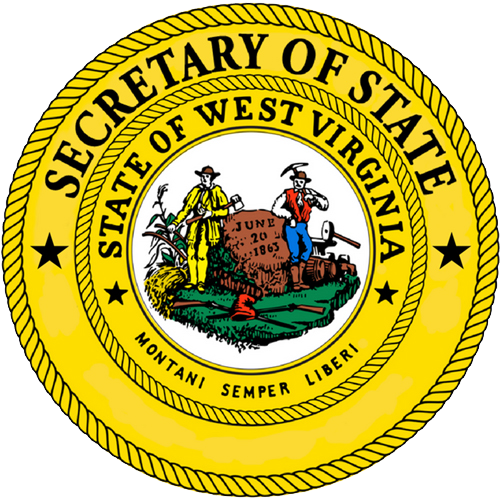
Joseph H. Diss Debar, an artist from Doddridge County, was chosen by the Legislature to prepare drawings for an official seal for the State of West Virginia. He submitted his drawings with an explanation of each detail. From these drawings, the Legislature adopted a seal which remains the Great Seal of the State of West Virginia to this day.
The seal contains the Latin motto Montani Semper Liberi, which means Mountaineers Are Always Free.
A large stone in the center of the seal stands for strength. On the stone is the date on which West Virginia was admitted to the Union, June 20th, 1863.
The farmer with his axe represents agriculture and the miner with his pick represents industry. In front of the rock are two rifles, crossed and surmounted at the place of contact by the cap of liberty, indicating that freedom and liberty were won and will be maintained by force of arms.
The Less Seal
The Less Seal of the State is the same as the Great Seal except in dimensions.
The Secretary of State is the official keeper of both the Great and Less Seals.
While the seal was designed and adopted with two sides, only the front side is in common use. The reverse side with its laurel and oak leaves, log house, hills and factories is the Governor's Official Seal.
Oaths of Office
The oath of office to be taken by all but a few public officers in West Virginia, from a city council member to the Governor of the State, is prescribed by the West Virginia Constitution. Article IV, Section 5 specifies the terms of the oath to be taken:
"Every person elected or appointed to any office, before proceeding to exercise the authority, or discharge the duties thereof, shall make oath or affirmation that he will support the Constitution of the United States and the Constitution of this State, and that he will faithfully discharge the duties of his said office to the best of his skill and judgment; and no other oath, declaration, or test shall be required as a qualification, unless herein provided."
When May the New Officer Take the Oath?
Often, a newly elected official may wish to have a ceremonial event at which friends are present and he or she takes the oath of office. In the case of an elected official, it is important that the official's election have been certified or declared as provided by law before the official oath is taken.
For example, a state official or legislator is not officially declared elected until the Legislature convenes and the official returns of the election are presented to and accepted by the Legislature. A circuit judge is not officially declared elected until the Governor issues a proclamation and a magistrate must be commissioned by the Governor. A county official is not officially elected until the board of canvassers certifies the election.
Generally, new officials must take the oath of office before beginning the duties of the office. The oath can be taken before the term begins, provided the election is certified and/or finally declared by the appropriate body.
Where is the Oath to be Filed?
The oaths of all state officials, including constitutional officers, justices, members of the Legislature, circuit judges, members of boards and commissions appointed by the Governor, executive appointees to administrative positions, and other offices not otherwise specified are filed with the Secretary of State. (See W.Va. Code §6-1-6)
The oaths of county officials and magistrates are filed with the clerk of the county commission, except that original oaths of members of the board of education are filed with the secretary of the board (the superintendent of schools) and a certified copy with the clerk of the county commission. (See W.Va. Code §6-1-6)
The original oaths of all municipal officials are filed with the recorder or clerk of the municipality and a certified copy with the clerk of the county commission of the county in which the major portion of the municipality is located. (See W.Va. Code §6-1-6)
Some oaths of office, such as those of election officials and certain appointed officers, are filed as prescribed in the section requiring the oath.